


Strengthening Infectious Disease Surveillance and Outbreak Response
Through an Artificial-Intelligence-Enabled Digital Platform
The project evaluates the implementation and impact of an AI-enabled digital platform designed to strengthen infectious disease early detection, outbreak investigation, and response in Indonesia.

Turning Surveillance Data into Earlier Action
Indonesia’s Early Warning Alert and Response System (EWARS/SKDR) provides an important foundation for infectious disease surveillance.
This project explores how an AI-enabled digital platform can complement existing systems by integrating multiple data sources, applying automated analytics, and supporting earlier outbreak detection, faster investigation, and more timely public-health response.
Programme Objectives
AI-Enabled Outbreak Detection & Investigation Platform
The digital platform supports real-time data collection, automated analytics, spatial outbreak analysis, and decision support. It is designed to help surveillance teams identify potential outbreaks, investigate emerging signals, assess potential spread, and translate surveillance information into actionable public-health intelligence.
Real-time data collection
Mobile-enabled synchronous and asynchronous
data collection from health facilities.
Automated analytics
Visualizes surveillance data and analytical results.
Spatial outbreak analysis
Maps outbreak events and assesses severity and potential spread.
Decision support
Provides interpretable AI results to support public health investigation and response.
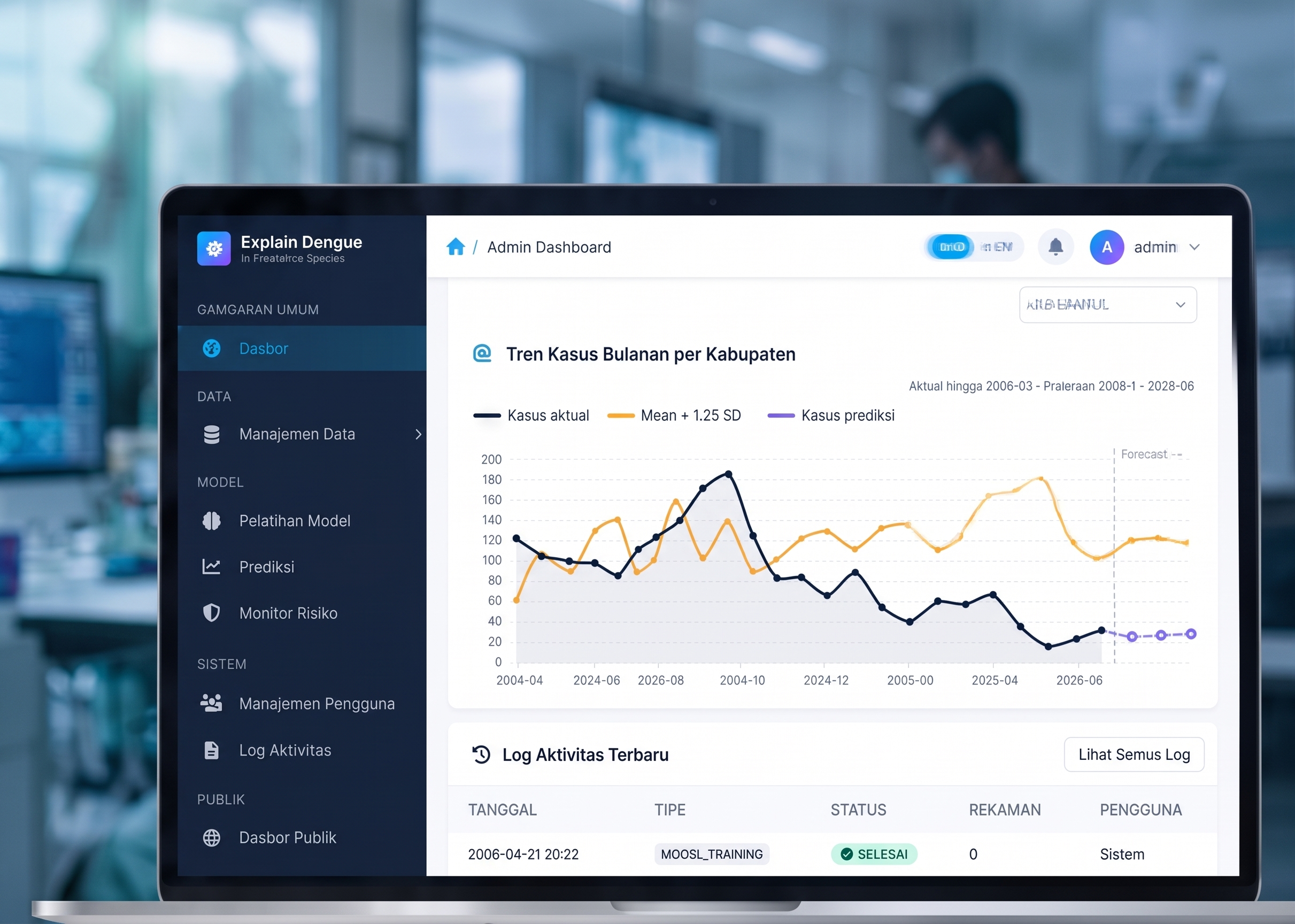
From Data in the Field to Faster Public Health Action
Testing in Real-World Healthcare Settings
The platform is being piloted in selected healthcare facilities across the Special Region of Yogyakarta to assess its effectiveness, usability, feasibility, acceptability, and implementation in routine surveillance settings.
Pilot Area
Special Region of Yogyakarta
4 regencies + 1 city
Up to 15 primary health centers
Target Diseases
Dengue, Influenza-Like Illness (ILI), Acute Diarrhoea, Malaria, and other priority infectious diseases
Timeline
January – December 2026
Platform implementation and evaluation
Evaluation Focus
Detection performance, timeliness, usability, acceptability, implementation feasibility, and sustainability
Can Digital Intelligence Make Outbreak Response Faster?
The project evaluates whether AI-enabled digital surveillance can improve the timeliness of outbreak detection, investigation, and response. The evaluation is connected to the 7-1-7 framework, emphasizing rapid detection, notification, investigation, and public-health response.
Time to Detection
How quickly can potential outbreaks be identified?
Early Outbreak Detection
Can the platform identify events before formal notification?
Supporting more timely outbreak detection, investigation, and response.
Time to Confirmation
How quickly can outbreaks be verified?
Timeliness of Response
Can public health action begin sooner?
Implementation Science & Sustainability
Implementation factors, barriers, and enablers are also assessed to understand how the platform can be sustainably integrated into routine surveillance practice.
Project Team









Partners & Collaborators

Latest Updates
View All News →All Project Team Members





All Partners & Collaborators
Building Smarter Surveillance
for Faster Public Health Action.
Combining artificial intelligence, implementation science, and local public-health expertise to strengthen infectious disease preparedness, outbreak detection, investigation, and response.